

Market Tug-of-War: Tech Tumbles as Energy Surges

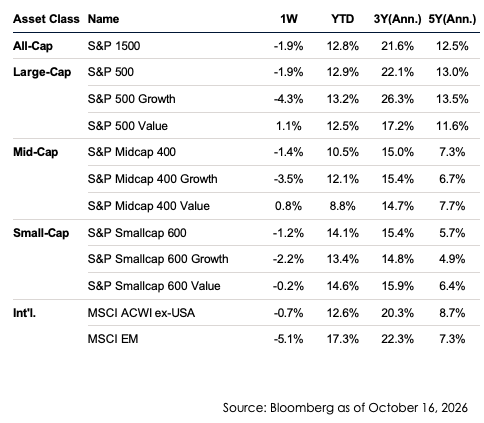
US equity markets delivered a mixed and volatile performance for the week, as a deepening selloff in AI-related stocks and a hotter-than-expected inflation report pressured growth-oriented areas of the market while defensive sectors held up. The S&P 500 fell 1.9% for the week, its worst weekly loss since June, as surging crude oil prices renewed inflation fears and chipmakers declined for an eighth consecutive session. Treasury yields moved lower on the week, as a mid-week spike following the inflation report was reversed by a flight to safety amid the equity selloff. WTI crude oil rose approximately 8.4% as supply disruptions tied to conflicts in the Middle East and Russia pushed prices above $100 per barrel. The September Consumer Price Index showed headline inflation of 3.7% year-over-year and core prices rising 0.3% month-over-month, both above expectations, while September retail sales increased 0.8%, driven largely by higher gasoline spending.
Equity Markets Overview
US equity markets posted mixed results for the week, with seven of eleven sectors finishing higher as investors rotated out of technology and AI-related stocks and into more defensive areas of the market.
The S&P 500 fell 1.9%, the Nasdaq Composite declined 4.5%, and the Dow Jones Industrial Average rose 0.7% for the week.
The top two performing sectors were Consumer Staples (+5.0%) and Energy (+5.0%), benefiting from defensive rotation and surging oil prices, respectively.
The bottom two performing sectors were Information Technology (-6.4%) and Consumer Discretionary (-1.9%), with technology weighed down by a collapse in AI-related sentiment as credit concerns at cloud-computing provider CoreWeave spread across the semiconductor and data-center ecosystem.
Fixed Income Markets Overview
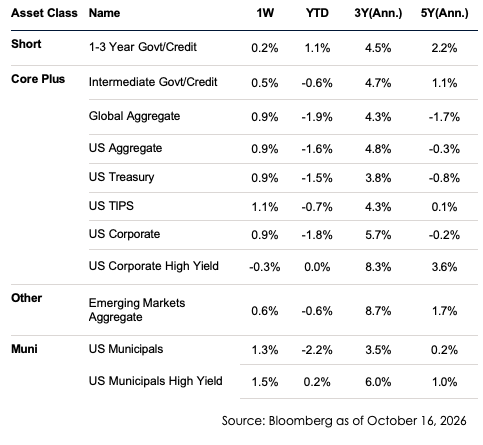
US Treasury yields declined across the curve over the week, as a sharp mid-week spike following the hotter-than-expected CPI report was reversed by a flight to safety amid the equity selloff, with the yield curve flattening as longer-dated yields fell more than shorter-dated yields.
The 2-year Treasury yield fell 6 basis points (from 4.80% to 4.74%), the 10-year yield fell 15 basis points (from 5.24% to 5.09%), and the 30-year yield fell 17 basis points (from 5.60% to 5.43%).
The primary driver of yield volatility was inflation, as the September CPI report came in above expectations and the Fed’s October Beige Book noted intensifying price pressures in several districts, particularly tied to elevated energy costs.
Market-implied odds of a Fed rate hike stood at approximately 17% for the October Fed meeting, while the Atlanta Fed’s GDPNow estimate for current-quarter real GDP growth rose to 3.6%, pointing to continued resilience in the growth outlook.
Alternative Markets Overview
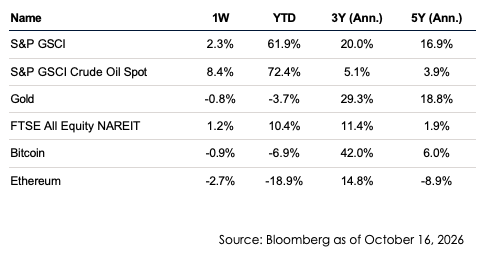
Commodity markets were broadly higher over the week, with the S&P GSCI gaining 2.3% as a sharp rally in crude oil led the complex.
WTI crude oil rose approximately 8.4% over the week, ending near $101 per barrel, as supply disruptions tied to conflicts in the Persian Gulf and Russia curtailed fuel-making capacity and pushed prices above $100 for the first time in weeks.
Gold declined approximately 0.8% for the week, closing near $4,170 per troy ounce, as stronger-than-expected inflation data put pressure on bullion.
Bitcoin declined on the week, falling 0.9% to close near $81,600.
Coming Up This Week
Notable earnings reports this week include Meta Platforms, Netflix, Tesla, and SpaceX.
On the economic front, investors will be closely monitoring Housing Starts, the S&P Global U.S. Manufacturing PMI, and the University of Michigan Consumer Sentiment Index.
As always, it's important to consider your investments within the broader context of your financial plan. We're here to assist and support you in any way we can. Feel free to reach out anytime with questions or to schedule a meeting.
Sincerely,
Ira Hermann, CLU, ChFC
Financial Advisor